The Canada Start-up Visa (SUV) is a federal immigration program that grants immediate permanent residence to foreign nationals who launch innovative, scalable companies in Canada with the support of designated Canadian incubators or investors.
Unlike many traditional residency-by-investment programs, the Canada SUV offers permanent residence from the beginning rather than a temporary permit tied to business performance.
The Canada SUV program is now paused for new applicants as of 1 January 2026. However, applicants who received a valid letter of support from a designated organization in 2025 have until 30 June 2026 to apply for permanent residency. The IRCC states that details of a new pilot entrepreneur program will be communicated in 2026.
This guide will provide a detailed breakdown of the Canada Start-up Visa, including current availability, benefits, requirements, application steps, costs, and realistic timelines.
Canada Startup Visa – Key Takeaways


Here is a quick glance at the core details of the Canada Start-Up Visa program.

No. The Canada Start-Up Visa (SUV) Program is paused for new applicants as of 1 January 2026, following major policy changes announced by Immigration, Refugees and Citizenship Canada (IRCC).
Only applicants who received a valid commitment certificate from a designated organization in 2025 may still apply for permanent residence, with a final deadline of 30 June 2026. New SUV work permit applications are no longer accepted, though current permit holders may apply for extensions.
IRCC has indicated that further details of a new targeted entrepreneur pilot will be communicated in 2026, possibly featuring lower intake caps and stricter eligibility requirements.
What happens if I already have a support letter?
Applicants who already hold a letter of support have six months (until June 2026) to apply for permanent residence. Your letter of support may be amended if necessary, but new letters cannot be issued. If a letter is amended to show a new date, the six-month deadline to apply for PR is still calculated from the original issuance date, not the amendment date.
Processing priority levels
IRCC divided processing for existing applicants into three priority levels:
Maximum priority
- Someone from your group has a Canadian work permit or has applied for one and is in Canada.
- You received a letter of support from an angel investor, venture capitalist, or business incubator, or has secured at least $75,000 in funding for your business.
Top priority
- If you received a letter of support from an angel investor, venture capitalist, or business incubator, or at least $75,000 in funding.
Final priority
- If you are on the non-funded, non-priority pathways, with or without a work permit.
What is the updated wait time for applicants with a support letter?
It is estimated that there are currently over 40,000 applicants in the system, and the government plans to approve about 1,000 applications this year, with a maximum of 1,500. If about 20% of the total applicants in the priority stream are processed first, the government has indicated that wait times could exceed 10 years for the remaining applicants.
If approvals remain at roughly 1,000 per year, applicants in the priority group can expect a processing timeline of 3 to 5 years if there aren’t any new changes.
The Canada Start-up Visa is an immigration program that allows foreign entrepreneurs to launch innovative, scalable businesses in Canada with the support of a Canadian investor or business incubator, in exchange for permanent residence upon approval. The goal of this immigration program is to attract brilliant foreign entrepreneurs who can build companies that boost the Canadian economy and create jobs for Canadian citizens.
On approval, applicants and eligible dependents get permanent residency, allowing them to live, work and study in Canada.

The Canada Start-Up Visa program offers several key benefits to foreign entrepreneurs. It provides opportunities for foreign nationals to build scalable and innovative businesses across the Canadian market (outside Quebec).
The Canada Startup Visa benefits include:
- No net-worth requirement: Unlike many investment residency programs, the Canada SUV has no net-worth requirements. The program focuses on securing an investment from a designated organization, demonstrating an innovative business concept, meeting the language requirements, and having enough settlement funds.
- Direct permanent residency: Holders obtain direct permanent resident status and can live, work, or study in Canada.
- Family inclusion: Primary applicants may include their spouse or common-law partner, and dependent children, in their permanent residence application. When approved, family members receive the same PR status and rights as the principal applicant.
- Great quality of life: According to the GCS Global Passport Index, Canada ranks 11th in quality of life, thanks to its strong social safety net, educational opportunities, and affordable healthcare.
- Investment flexibility: Applicants can invest through one of three routes: CAD $75,000 through an angel investor, CAD $200,000 through a venture capital firm, or get accepted into a designated Canadian business incubator.
- Access to welfare and healthcare: Permanent residents may apply for provincial healthcare coverage and are entitled to social benefits under Canadian law. This is subject to eligibility rules.
- Path to citizenship: Permanent residents can apply for Canadian citizenship after three years of continuous permanent residence.
There is no minimum personal investment requirement imposed by IRCC. However, successful SUV applications receive a letter of support and commitment to invest a specific amount of money.
The investment details vary based on the designated organization, which includes:
- Venture capital funds of CAD$ 200,000: International entrepreneurs require to raise a significant capital investment of CAD$ 200,000. Venture capitalists often support early-stage start-ups that can deliver fast results.
- Angel investor group of CAD$ 75,000: Applicants must secure at least CAD$ 75,000 of capital investment. National Angel Capital Organization tends to prioritize scalable start-ups in Canada’s tech network and business models with excellent market potential.
- Business incubator: This is a self-funded support option with no minimum investment. However, you must be accepted into a Canadian business incubator program. It provides strong networking, a structured environment, and access to resources.

To be eligible for the Start-up Visa program, you must have a qualifying business, a letter of support from a designated organization, meet the language requirements, and provide sufficient funds to settle. International entrepreneurs can apply as individuals or as a group of up to five owners.
Here is a detailed look at the Startup Visa Canada requirements.
Have a qualifying business
To have a qualifying business, each applicant must hold 10 percent or over of the total voting rights. Together, SUV program applicants and the designated organization must hold more than 50 percent of the total voting rights.
If your application is successful, you will need to incorporate your business in Canada, manage it actively from within the country, and ensure an essential part of its operations takes place in the country.
Have support from a designated organization
Designated organizations are business groups authorized to fund or mentor startup businesses through the Canada Entrepreneur Visa. The main applicant must contact a designated organization (e.g., a venture capital fund, an angel investor group, or a business incubator).
Immigrant entrepreneurs must convince the designated organization to support their SUV application and get an official letter of support. The organization will also need to send a commitment certificate directly to the Canadian immigration authorities.
Meet the language requirements
The SUV application requires you to meet level five language requirements based on the Canadian Language Benchmark (CLB). The Canadian Government provides a language test to determine your CLB level in reading, writing, listening, and speaking.
Bring enough funds to settle
Immigrant entrepreneurs must demonstrate sufficient funds to settle in order to apply for the Startup Visa program. The amount needed depends on the number of family members. In 2025, the amount starts at CAD$ 15,263 for a single applicant and goes up to CAD$ 40,392 for a family of seven.
The application process for the Canada Startup Visa is relatively straightforward as long as you follow the instructions on the Canada Startup Visa official website. It involves the following steps:
1. Create an account or sign in using the Canadian Permanent Residence (PR) Portal: The start-up visa program is called the Start-Up Business Class on the portal.
2. Get your documents ready: The forms to fill out can be accessed in the portal, and you will need the following supporting documents:
- Travel document or passport
- Language proficiency test results
- Letter of support
- Birth certificates
- Identity and civil status documents
- Children’s information
- Police certificates
- Photos of you and each family member in Canada
- Fee payment receipt
- Proof of settlement funds
3. Pay your application fees: Your application fees may be paid online. These include processing fees, right of permanent residence fee, and a biometrics fee.
4. Submit your online application and wait for it to be processed.

Here are the most common mistakes business experts make when applying for the Start-up Visa program (SUV program) and tips on how to avoid them.
- Incorrect or incomplete documents: When you fill out all the paperwork double-check every form and document you attach to the Start-up Visa program. Provide well-established evidence to support your application.
- Weak business plan: International entrepreneurs must have a clear and detailed business plan. The business plan must outline your goals, strategies, and operations. Use the business proposal to demonstrate you can hire Canadian employees.
- Lack of funds: Have enough funds to settle in Canada and provide a detailed review of your financial statements.
- Inadequate research: Many applicants don’t invest enough time to evaluate Canadian immigration policies and choose the wrong business model. Review the policies before submitting the work permit application.
- Poor interview skills: Interviews are a big part of the visa process. The SUV program requires new business to stand out.
- Not using an SUV attorney: SUV applicants may want to complete the visa application process on their own, but they are more likely to make mistakes. Using a Canada Start Up Visa attorney will help you navigate the complex documentation and eligibility requirements and increase your chance of approval.
Processing times change often and may take 40 months or more due to existing backlogs and intake limits. Applicants should check the official IRCC processing time tool for current estimates.
Because of recent changes to the Start-up Visa program, the program has experienced significant backlogs of pending applications. As of August 2025, the IRCC updated its average processing times to 52 months. This processing time estimation is based on the average time it took to process applications in the past 6 months. The duration can vary and is updated weekly. The application could also face delays if it is incomplete or complex.
In the meantime, SUV applicants with a commitment certificate can get a temporary work permit to start their business operations.
The immigration application fees for the Canada Start-Up Visa program may range from $1,810 to $2,385. The fee can vary based on whether you need permanent residency and include family members.
To pay your application fee online, you can spend:
- $2,495 for processing and right of permanent residence fee
- $1,895 without right of permanent resident fee
- $1,590 for including a spouse or a partner, including right of permanent residence fee
- $990 to include your spouse or partner (without right of permanent residence fee)
- $270 for including a dependent child
These fees in Canadian dollars don’t include the cost of your business investment. A Canada startup visa lawyer can provide the correct price analysis and help you navigate the application process. They can simplify the immigration laws and regulations so you can make an informed decision.
The Immigration, Refugees and Citizenship Canada (IRCC) has introduced key changes to immigration law regarding the Investment Visa Canada. The Canadian government hopes to address backlogs by reducing the permanent residency target by 25 percent. The overall target for PR status is expected to change from 485,000 in 2024 to 365,000 by 2027, recent Canada Startup Visa statistics show.
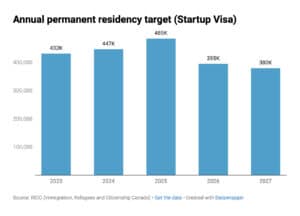
Canadian immigration authorities implemented a cap limit on the Start-up Visa program, allowing a designated organization to only support up to ten start-ups annually. These limits are expected to continue until 31 December 2026. “But just because the program became more competitive, it doesn’t mean there are fewer options for success,” explains Jelena Sivcev at GCS. “It’s about quality over quantity.”
Another update to the SUV program is the introduction of priority processing for certain applications. Start-ups that have secured funding from a Canadian venture capital or angel investor, or have been accepted into a top-tier Canadian incubator, will now be fast-tracked. This applies even to applications already in the backlog. The goal is to reward ventures with strong Canadian investment, bring entrepreneurs to Canada sooner to scale their companies, and use resources more efficiently.
This investment program continues to attract and retain foreign nationals. Our consultants and lawyers at GCS can simplify immigration law for your entrepreneurial journey or any future business activities. They can keep you up to date with the recent changes to every immigration process and assess your eligibility.
The IRCC has signaled plans for a new, more selective entrepreneur pilot in 2026 to replace the SUV, though full details have not yet been published. However, some of the expected design details for the 2026 Entrepreneur Pilot include:
- Lower intake caps: There may be significantly lower quotas to prevent the backlogs of previous programs.
- Stringent eligibility: Applicants may be required to demonstrate proven business traction and genuine, operational business activity before gaining permanent residence.
- Focus on economic growth: Founders whose businesses align directly with Canada’s core economic goals and innovation sectors may be prioritized.
What are my options now?
With the SUV paused, foreign entrepreneurs can consider two active pathways:
Provincial Nominee Program (PNP) entrepreneur streams: This is for high-net-worth individuals who want to start, buy, or invest in a business in a specific Canadian province. Founders apply through individual provinces rather than the federal government, though requirements vary by province.
Quebec Immigrant Investor Program (QIIP): For high-net-worth individuals who want to settle and support or acquire businesses in Quebec. Applicants do not need to actively manage the business, but must invest CAD $1.2 million and make a non-refundable contribution of CAD $200,000.
How Can Global Citizen Solutions Help You?
Global Citizen Solutions is an advisory migration consultancy firm with years of experience delivering bespoke residence and citizenship by investment solutions for international families. With offices worldwide and an experienced, hands-on team, we have helped hundreds of clients worldwide acquire citizenship, residence visas, or homes while diversifying their portfolios with robust investments.
We guide you from start to finish, taking you beyond your citizenship or residency by investment application.
