The Global Atlas of Risk and Readiness (GARR) is a comparative framework designed to assess structural competitiveness and long-term resilience across national economies. Unlike traditional rankings focused on short-term growth or economic size, the GARR integrates indicators capturing both systemic risk exposure and forward-looking readiness.
The core premise is that sustainable competitiveness depends on a country’s ability to limit structural vulnerabilities while maintaining the institutional, technological, and economic capacity to generate future growth. Countries performing strongly across both dimensions are more likely to provide stable environments for capital allocation, long-term investment, and wealth preservation.
The framework is built on two equally weighted pillars:
- Risk & Structural Stability: 50%
Measures macroeconomic discipline, institutional predictability, and systemic resilience. - Readiness & Market Opportunity: 50%
Assesses capacity to capture emerging opportunities through innovation, human capital, and economic transformation.
This structure reflects established literature emphasizing institutional quality, macroeconomic stability, and technological capability as key drivers of long-term performance (North, 1990; Acemoglu & Robinson, 2012; Hausmann et al., 2014).
Pillar 01/ Risk & Structural Stability
This pillar evaluates structural conditions shaping economic predictability and resilience. Indicators include:
- Demographic sustainability
- Geopolitical exposure
- Macroeconomic stability
- Regulatory predictability
- Institutional quality
- Fiscal discipline
- External financial resilience
These variables directly influence investor confidence, sovereign credibility, and policy stability. Strong performance reflects disciplined macro management and institutional reliability, qualities increasingly critical in a volatile global environment.
Pillar 02/ Readiness & Market Opportunity
The second pillar assesses whether economies possess the depth and capacity to sustain long-term growth. It is structured across five domains:
- Governance & Institutional Strength: rule of law, regulatory transparency, investor protection
- Digital & Innovation Capacity: innovation systems, AI readiness, digital infrastructure
- Human Capital: workforce quality, education, productivity potential
- Economic Fundamentals: complexity, growth dynamics, market size, financial depth
- Environmental & Energy Resilience: sustainability and energy security
Together, these dimensions capture the ability not only to withstand shocks, but to convert structural strength into sustained growth.
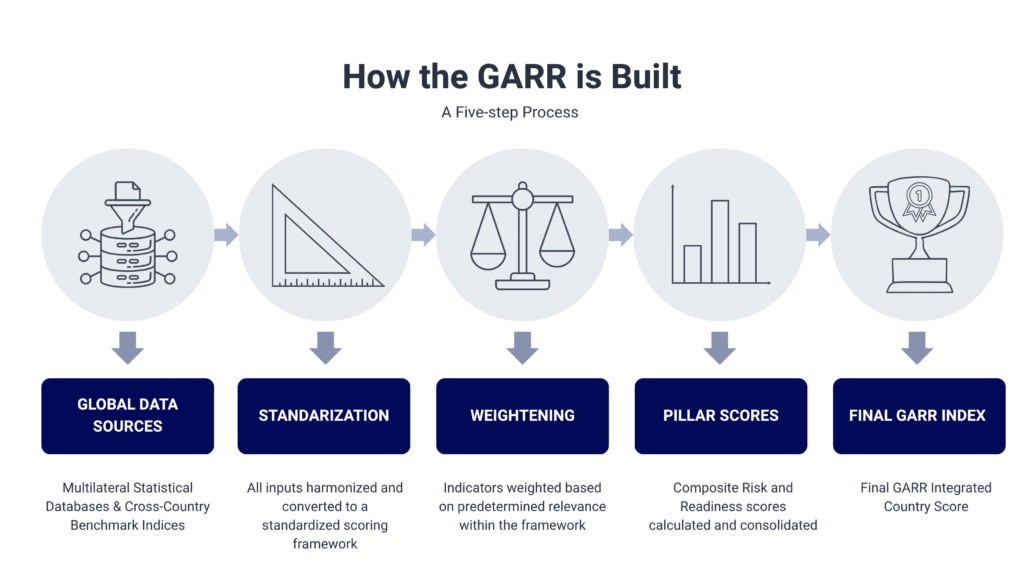
To ensure comparability across jurisdictions, all indicators are standardized to a 0–100 scale. Variables representing risk exposure are directionally adjusted so that higher values consistently indicate stronger performance across the index.
Each pillar is constructed as a weighted composite of its underlying indicators. The weighting structure reflects strategic relevance rather than short-term volatility, emphasizing institutional strength, fiscal sustainability, market depth, and technological preparedness. The two pillars are then combined with equal weight.
The weighting framework reflects a policy-oriented view of competitiveness.
Within the Risk pillar, geopolitical exposure and fiscal sustainability are prioritized due to their systemic implications. Within the Readiness pillar, institutional quality and economic fundamentals carry greater weight, reflecting their central role in attracting long-term capital.
Innovation, digital capacity, and energy resilience are incorporated to capture adaptability in a rapidly evolving global economy. The weighting structure remains fixed across countries to ensure transparency and comparability.
The Atlas relies on internationally recognized public data sources. Inputs undergo validation procedures including consistency checks and directional review.
Sensitivity testing ensures results are not driven by individual variables or short-term fluctuations. Where data gaps exist:
- The most recent available data is used
- Countries with multiple missing indicators are excluded
- Limited gaps may be filled using regional averages
This approach prioritizes robustness while maintaining comparability.
While the index is designed to provide a robust and comparable cross-country framework, it may simplify complex economic, political, and institutional realities into a set of standardized indicators.
In addition, the reliance on publicly available datasets introduces potential inconsistencies related to data quality, reporting standards, and time lags, especially in emerging markets. The equal weighting of the Risk and Readiness pillars reflects a deliberate methodological choice, but alternative weighting schemes could yield different rankings depending on investor priorities or sectoral focus.
As such, the GARR should be understood as a high-level benchmarking tool rather than a predictive model, and its findings are best used in conjunction with more granular, forward-looking, and jurisdiction-specific analysis.