
According to the UN Population Division, approximately 304 million people were international migrants in 2024, comprising 3.7% of the global population((United Nations Department of Economic and Social Affairs. “International Migrant Stocks Overview.” Migration Data Portal, 2025, www.migrationdataportal.org/themes/international-migrant-stocks-overview.)). This substantial movement of people reflects diverse migration patterns worth exploration.
An interesting concept shaping relocation patterns is counterurbanization, the demographic shift from urban to rural areas. Counterurbanization is about the revival of rural populations as individuals seek improved employment opportunities and a perceived higher quality of life((Counterurbanization.” ScienceDirect, www.sciencedirect.com/topics/social-sciences/counterurbanization.)).
There are a number of motives behind counterurbanization, such as aspirations for a rural lifestyle, environmental considerations, housing-related motives, economic factors, and, more recently, health-related drivers linked to the COVID-19 pandemic. Scholars note that the first three form a cluster of environmental factors that are especially influential in prompting counter-urban migration. The pandemic intensified these trends, not only prompting temporary relocations and second-home purchases but also contributing to a sustained increase in permanent moves to non-urban areas. This shift has been particularly evident among families and among well-educated, highly skilled individuals((Tammaru, Tiit, et al. “Did the Pandemic Bring New Features to Counter-Urbanisation? Evidence from Estonia.” Journal of Rural Studies, vol. 97, Jan. 2023, pp. 345–355, doi:10.1016/j.jrurstud.2022.12.012. )), including digital nomads.
Digital nomads represent a unique case study within this counterurbanization movement, as their location independence allows them to actively seek out emerging secondary destinations. As of 2025, 13 of the world’s 50 fastest-growing digital nomad hotspots((“Fastest Growing Digital Nomad Hotspots of 2025.” Nomads.com, 2025, https://nomads.com/fastest-growing-remote-work-hubs.)) are located outside national capitals. Among them are Cape Town, Shanghai, Mallorca, Hamburg, Zurich, and Melbourne, signaling remote workers’ preference for vibrant secondary cities over traditional metropolitan centers.
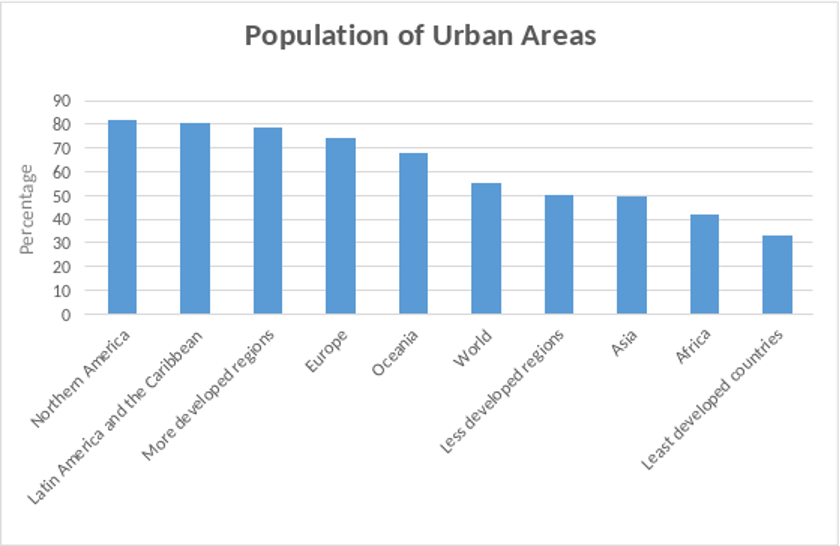
Analyzed from United Nations World Urbanization Prospects: The 2018 Revision.

Today, 55% of the world’s population lives in urban areas, a proportion that is expected to increase to 68% by 2050((United Nations Department of Economic and Social Affairs. “68% of the World Population Projected to Live in Urban Areas by 2050, Says UN.” United Nations, 2018, www.un.org/uk/desa/68-world-population-projected-live-urban-areas-2050-says-un.)).
All over the world, so-called “second cities” are experiencing rapid growth. These urban areas, smaller than the dominant national capitals, offer a combination of lower living costs, more space, expanding local economies, and a less congested lifestyle. This makes them increasingly attractive alternatives to their overcrowded and expensive counterparts.
In 2024, Porto recorded a 67% year-over-year increase in foreign remote workers, many of whom relocated from higher-cost European capitals, including Lisbon((“Why Second Cities Are the Next Big Thing.” World Population Review Newsletter, World Population Review, 2025, https://wpr-newsletter.beehiiv.com/p/why-second-cities-are-the-next-big-thing?utm_source=wpr-newsletter.beehiiv.com&utm_medium=newsletter&utm_campaign=why-second-cities-are-the-next-big-thing&_bhlid=bf9dc34bdb803b92bb59674c0745c83f83002883.)). This rise reflects broader trends in mobility where individuals and families, empowered by remote work opportunities, seek locations that balance economic opportunity with an improved quality of life.
In Australia, growing numbers of young adults are leaving major metropolitan centers such as Perth and Sydney in favor of regional hubs like Townsville. This shift is driven by the appeal of affordable housing, greater career prospects, and a more balanced lifestyle. In 2024, this aspiration is especially evident among Gen Z and Millennials, many of whom are choosing to establish long-term roots outside capital cities. Townsville, Queensland, for instance, has experienced a notable influx of younger residents, a trend partly explained by its median house price of $440,000. This is substantially lower than the national median of $973,300, which makes homeownership a more realistic goal for first-time buyers((Foster, Ally. “Great Slow Down: New Trend Sweeping Australia as Young People Ditch Capital Cities.” News.com.au, News Corp Australia, 2024, www.news.com.au/lifestyle/real-life/news-life/great-slow-down-new-trend-sweeping-australia-as-young-people-ditch-capital-cities/news-story/d9ec0a7991119a7d107186a9e9dad948.)).
Similarly, in the United States, small towns and rural communities are attracting younger populations at the fastest rate in decades, with no indication that the trend will slow. Since 2020, two-thirds of national population growth has occurred in regions with fewer than one million inhabitants, reversing a long-standing preference for urban living. Millennials and Gen Z in the U.S. are making deliberate choices to relocate to rural areas with strong natural amenities. For example, Chaffee County, Colorado, located in the Rocky Mountains and boasting a high USDA natural amenity score has seen its younger workforce double compared with the national average over the past decade((Farberov, Snejana. “Why Young Adults Are Moving to Small Towns at the Highest Rate in a Decade.” New York Post, 2025, https://nypost.com/2025/03/14/real-estate/young-adults-are-moving-to-small-towns-at-the-highest-rate-in-a-decade/.)).
A noteworthy observation was made at the recent Digital Nomad Conference 2025, held at Nebrija University in Madrid, co-organized by Global Citizen Solutions. Santiago Yerga (Director General of Migration Management at Spain’s Ministry of Inclusion, Social Security, and Migrations) highlighted how Spain’s Digital Nomad visa encourages remote workers to settle in economically deprived regions known as España vaciada. The National Network of Welcoming Villages for Remote Work has already grown to include 77 municipalities((Listado de Pueblos – Red Nacional de Pueblos Acogedores.” Red Nacional de Pueblos Acogedores, El Hueco, https://pueblosacogedores.com/listado-pueblos/.)). The initiative promotes not just professional opportunities, but also an immersive experience: remote workers are invited to engage with the daily life of small towns, fostering a deeper understanding of rural realities. This approach aims to reshape the relationship between rural and urban areas, reframing rural Spain as a viable and enriching place to both live and work.
Recently, GCS released its Global Digital Nomad Report 2025, with the following destinations being in the top 10.
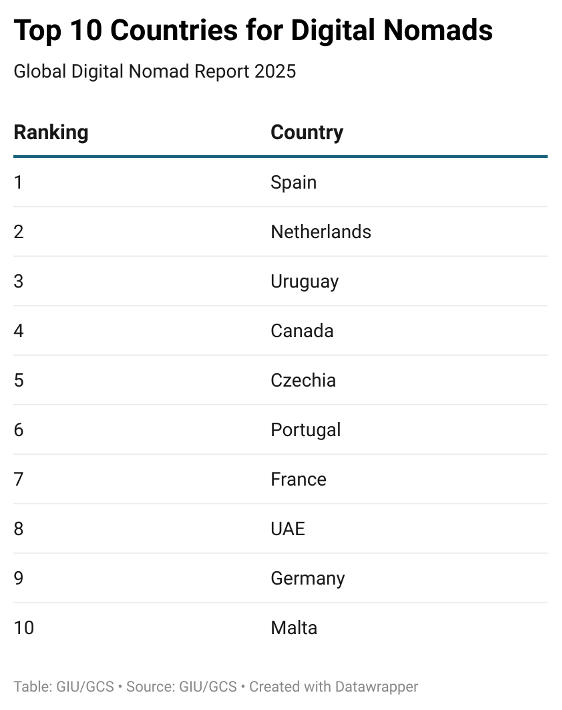
The rankings are based on six main dimensions – Procedure, Citizenship and Mobility, Tax Optimization, Economics, Quality of Life, and Tech & Innovation – each composed of carefully selected indicators relevant to the digital nomad lifestyle. Indicator selection drew from academic research, industry surveys, expert analysis, and client insights to capture actual nomad priorities and challenges.
Considering the top 10 rankings, it is particularly noteworthy to examine which secondary cities are emerging as digital nomad destinations within these countries.
For instance, Portugal presents a compelling case study, with several cities beyond Lisbon establishing themselves as thriving digital nomad hubs. Notable examples include Porto, with its vibrant tech scene and historic charm; Coimbra, offering a rich academic atmosphere; and Aveiro, known for its picturesque canals and growing startup ecosystem.
- Porto – A more affordable alternative to Lisbon with plenty of excellent cafés and co-working spaces, with a vibrant arts scene and hipster atmosphere. The city also boasts thriving online communities and regular digital nomad meetups((“Porto Digital Nomad Guide.” Portugalist, 4 June 2024, www.portugalist.com/porto-digital-nomad/.)).
- Coimbra – Home to the prestigious University of Coimbra, one of Europe’s oldest universities, the city offers a vibrant intellectual and cultural scene that appeals to nomads who value learning and history. The city invests heavily in digital connectivity which provides free, high-quality Wi-Fi in public spaces, gardens, and academic institutions. Even more affordable than Porto or Lisbon, Coimbra also stands out for its sustainable 15-minute city concept((“Digital Nomads – Official Coimbra Tourism Website.” Visite Coimbra, 2025, https://visitecoimbra.pt/en/live-coimbra/digital-nomads/.)).
- Aveiro is noted for its low crime rates and friendly locals, creating a safe and inviting atmosphere for digital nomads, particularly female travelers. The city is less expensive and less touristy than Porto((“Aveiro for Digital Nomads.” Nomads, 2025, nomads.com/aveiro.)).
Moving to the top country according to the Digital Nomad Index 2025: Spain. Notable locations here include Barcelona, Valencia, Málaga and Canary Islands.
- Barcelona – Community-centered with one of Europe’s largest digital nomad networks. Community events range from coworking meetups and skill-sharing sessions to cultural excursions and sunset beach gatherings. The Barcelona Digital Nomads Community serves as both support network and social hub, ensuring remote workers never feel isolated. The city offers high-speed internet infrastructure with average speeds of 200+ Mbps (up to 1 Gbps via fiber), widespread 5G coverage, and free public WiFi hotspots for reliable connectivity. With another notable advantage – mild winters and warm summers((“Barcelona Digital Nomads.” Barcelona Digital Nomads, 2025, www.barcelonadigitalnomads.com/.)).
- Valencia – A budget-friendly alternative to larger Spanish cities, Valencia boasts a rapidly growing digital nomad community. The expanding scene includes regular meetups via platforms like Meetup.com and Facebook groups (e.g., Valencia Digital Nomads), plus networking events at coworking spaces like Wayco that foster meaningful social connections.
- Málaga – An emerging tech hub and a prime digital nomad destination, blending a sunny Mediterranean climate, vibrant culture, and affordable living for an ideal work-life balance. It also has a growing community offering regular meetups, while excellent safety, cosmopolitan vibes, and strong transport links via its international airport connect nomads to Spain and Europe.
- The Canary Islands – Are increasingly emerging as a destination for remote workers rather than solely for tourists. The region combines reliable infrastructure, relatively affordable living costs, and a supportive community, creating conditions conducive to sustained productivity. Stable internet access, well-equipped coworking environments, and a slower pace of life enable professionals to work effectively while maintaining well-being. At the same time, the mild year-round climate and diverse natural landscapes provide opportunities for recreation, fostering a balanced integration of work and lifestyle.
In Germany, an appealing secondary city for nomads:
- Munich – A hub for companies like Siemens and BMW, Munich attracts tech and entrepreneurship nomads with abundant networking opportunities. With a large expat population and English widely spoken in professional settings, the city is highly accessible for international remote workers. The expansive expat community and numerous co-working options make Munich an excellent nomad destination. Munich’s Green City initiative features excellent public transportation, pedestrian zones, and shared mobility systems with bikes and e-scooters, reducing car dependency making it also a sustainable option. While not among Europe’s cheaper cities, it offers excellent value for money with bargains still available((Burgess, Tara. “Living in Munich: A Guide For Digital Nomads.” Goats On The Road, 2019, www.goatsontheroad.com/living-in-munich/.)).
Moving to UAE:
- Dubai – Infrastructure excellence with over 23,000 Wi-Fi hotspots and coworking spaces like Nook and WeWork providing reliable, high-speed internet for digital nomads. Dubai’s thriving tech ecosystem, featuring 5,600 startups in 2024, supports extensive networking and innovation opportunities, particularly appealing to nomads in tech and creative industries. However, it is worth mentioning that the living costs and rents are much higher in Dubai than in the mentioned European secondary cities((“Why Dubai Is the Ultimate Destination for Digital Nomads and Remote Workers in 2025.” Away Lands, 21 July 2025, www.awaylands.com/story/why-dubai-is-the-ultimate-destination-for-digital-nomads-and-remote-workers/.)).
And finally, heading towards Latin American destinations, particularly Uruguay, the third country in Global Digital Nomad Report 2025:
- Punta del Este – Known for stunning beaches like Playa Brava and Playa Mansa, Punta del Este offers a relaxed, upscale coastal lifestyle with surfing, seafood restaurants, and sunset views—ideal for nomads seeking work-life balance. The mild climate features year-round temperatures of 17–25°C and excellent air quality (0 µg/m³), perfect for outdoor activities like surfing, kayaking, or simply relaxing by the coast((“Punta del Este Nomad Guide.” Punta, 2025, punta.app/digital-nomad-guides/punta-del-este-maldonado-department-uruguay.)).
The analysis reveals a noticeable shift in digital nomad preferences toward secondary cities and alternative destinations, driven primarily by various factors including the escalating costs of living in major capitals. This migration pattern aligns with the broader counterurbanization trend, where remote workers are deliberately choosing locations that offer economic accessibility without compromising quality of life. Cities like Porto, Valencia, Munich, and Punta del Este exemplify this movement, providing nomads with essential elements including affordable housing, reliable infrastructure, and most importantly, vibrant communities that foster both professional networking and social connection. Additionally, these destinations often feature favorable climates and sustainable urban planning, creating environments conducive to work-life balance. As traditional metropolitan centers become more expensive and overcrowded, this trend toward more affordable and livable secondary cities suggests digital nomads are not chasing prestige locations but discovering authentic communities that support both productivity and personal well-being.