

Sunshine, tranquility, and a lower cost of living have long made Spain an attractive destination for international retirees. But increasingly, we are seeing another factor enter the decision much earlier: what life will actually look like once the move is made.
For many retirees, the question is no longer simply where they can afford to live. It is where they can continue to have an active, connected life.
That matters because retirement can change more than someone’s working life. It can also remove many of the routines that previously created social interaction, colleagues, daily commutes, professional networks, and familiar neighborhoods. Moving abroad adds another layer: even a financially comfortable retiree can find themselves socially disconnected in a new country.
Spain has an advantage that is easy to overlook. In many parts of the country, social interaction is already built into everyday life.
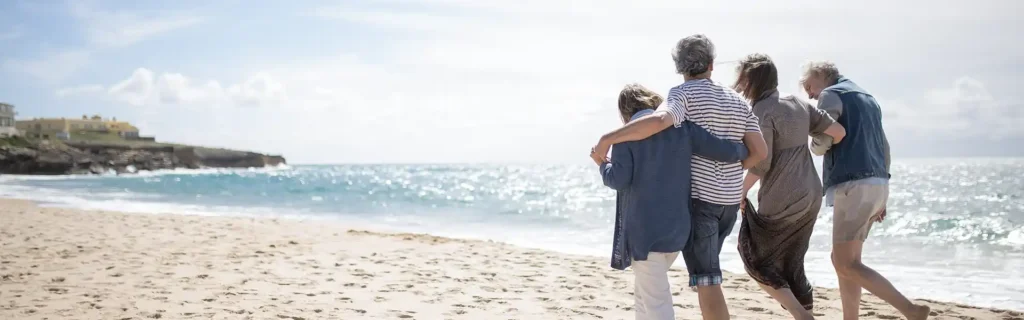
When we speak to clients considering a move to Spain, the cost of living is important, but it is rarely the only consideration.
Today, the questions are more personal: How will I meet people? What will I do during the week? Where will I find activities that I enjoy? Will I be able to build a social circle outside my immediate family?
These are not secondary questions. They can determine whether an international retirement feels like a genuine new chapter or simply a change of address.
Spain’s appeal is that many of the answers can be found in the ordinary routines of local life.
Spain’s foreign resident population also shows how established international communities have become. At the end of 2025, the country had more than 7.5 million foreign residents with valid residence documentation, an increase of 4.5% over the previous year, according to Spain’s Permanent Immigration Observatory.
For a retiree arriving from abroad, that matters. They are not entering a community with no international presence, but a place where foreign residents have already become part of the local social fabric.
The most interesting part of Spain’s social environment is that it does not depend entirely on private clubs or expat organizations.
Across Spanish towns and cities, municipal cultural centers, centros culturales, provide a ready-made structure for people to stay active and meet others. Programs can include aqua gym, dance, language courses, arts and cultural workshops, card games, and other group activities.
The value is not simply the activity itself. It is the routine around it: attending the same class each week, recognizing familiar faces, and gradually turning acquaintances into friends.
The same applies to piscinas municipales, where swimming and exercise can be accessible at relatively low cost, and to public parks and squares where activities such as pétanque create informal opportunities for people to spend time together.
These are small features of everyday life, but they can have a significant effect on someone starting again in a new country.
For a retiree who has left behind a workplace and an established social circle, having somewhere to go on an ordinary Tuesday can be just as important as having somewhere beautiful to live.
There is also a separate layer of support for older adults who need more structured assistance. Centros de día, or day centers, provide daytime support, meals, assistance with medication and daily activities, as well as company from peers. They also give families greater reassurance that an older relative is not spending the day alone or without support.
These services were not designed specifically for international retirees. That is precisely what makes them relevant. New arrivals are stepping into a social infrastructure that already exists rather than having to create one from scratch.
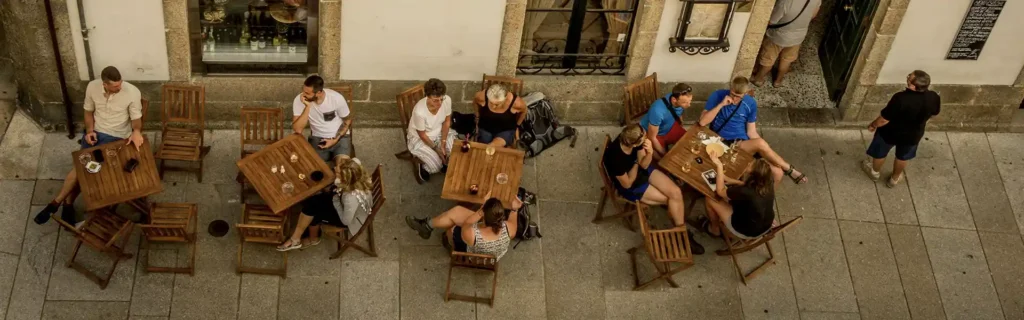
This does not mean that every retiree is looking for the same experience.
For some, an established international community provides the easiest starting point. Alicante remains one of the strongest destinations for international retirees, while Dénia and Altea offer similar advantages. Their long-established British and Northern European communities provide a ready-made social network, from walking groups and English-language quiz nights to golf and bowls clubs and regular expat meet-ups. For someone starting a new social life abroad, having these networks already in place can make the first few months feel less uncertain.
Others are looking for deeper integration into Spanish life. Clients considering Galicia or the Basque Country are often drawn to their strong regional identity, cooler climate, and more locally rooted communities. Village fiestas, parish life, and, in the Basque Country, sociedades gastronómicas — private members’ clubs where locals gather to cook and eat together — offer different ways to become part of everyday life. In our experience, retirees choosing these regions are often more interested in integrating into Spanish life, making language learning an important part of building a social circle.
For others, shared activities are the foundation of community. The Canary Islands combine a mild climate with an outdoor lifestyle and an active retiree community. Hiking clubs, sailing, and outdoor fitness groups provide regular opportunities to meet people and build friendships around shared interests.
The point is not that one type of community is better than another. The right destination is the one that matches the kind of social life the retiree actually wants. Some people want the reassurance of an established English-speaking network; others see relocation as an opportunity to integrate more deeply into Spanish life, while others may build their social circle around activities and shared interests.
Good relocation advice starts with understanding the person’s desired lifestyle, rather than simply recommending the destination that is most popular with other retirees.
In our experience, the clients who end up happiest in Spain are not necessarily the ones who researched the most before moving. They are often the ones who researched what everyday life would actually look like.
Most due diligence around a retirement move still defaults to property, healthcare, and climate — all worth checking. What it tends to leave out is the variable that actually predicts whether someone thrives: what an ordinary week there will look like once the novelty of the move has worn off.
We often suggest visiting outside peak season for exactly this reason. A town in August, full of summer visitors and one-off events, can give a misleading picture. Visit the same town on an ordinary Tuesday in February, when the centro cultural is running its normal winter program, and you get a much clearer sense of the community you would actually be joining.
It is also worth thinking about what kind of community you want. Alicante, Dénia, and Altea offer a fast route into established English-speaking networks, while other regions offer a slower, more immersive route into Spanish community life.
Neither is necessarily better — but knowing which experience you want can make a significant difference to how settled you feel after the move.
One useful exercise is to identify the specific class, pool, or club you would realistically attend each week. It forces you to think beyond “staying active” and towards what everyday life in Spain could actually look like.
For non-EU retirees, Spain’s Non-Lucrative Visa can provide a route to residency for those who meet the relevant financial, insurance, and other requirements. But getting the visa approved is not the same thing as building a successful life in Spain.
Spain’s appeal to retirees has never been only about sunshine and cost of living, and the 2025 permit numbers suggest more people are recognizing that explicitly.
What’s changed is that international retirees are now choosing Spain with social well-being as a stated priority, not an afterthought, and Spain’s everyday public infrastructure happens to make that priority remarkably easy to satisfy.
For advisers and clients alike, that reframes the real question behind a Spanish retirement: not “can I afford to live there?” but “will I actually build a life there?”