
Europe dominates the 2026 Global Passport Index like no other region on earth. Nine of the world’s ten strongest passports are European, and the continent claims the global number one spot outright. What’s remarkable isn’t just the scale of this dominance, but its character: the regional top five reads as a near-clean sweep of the global leaderboard, and the countries leading the charge defy the usual assumptions about where passport power comes from.
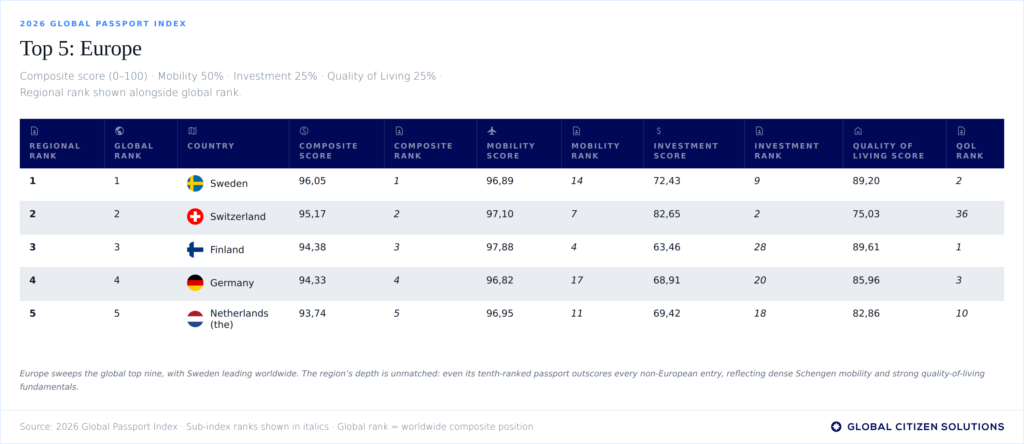
A Nordic-Alpine bloc sets the standard. Sweden, Switzerland and Finland occupy the global podium, and the pattern behind their success says something important about what a passport is really worth in 2026. The top of the index has nothing to do with size or geopolitical weight. The world’s largest economies and most powerful states don’t lead here. Instead, the summit belongs to small, high-trust, high-mobility nations that score consistently across every pillar the index measures. It is breadth and reliability, not raw power, that defines an elite passport.
One of the most telling features of the European leaderboard is just how tightly bunched the scores are. The gap separating Sweden at number one, with 96.05 points, from France at number ten, with 92.39, is less than four points. For all practical purposes, Europe’s elite passports are interchangeable. Whether the question is visa-free travel or the freedom to relocate, the differences between them are marginal. The small reshuffles that happen from one year to the next reflect minor adjustments rather than any real gap in usefulness. A holder of any top-ten European passport enjoys essentially the same global access as the holder of the very best.
That observation becomes even sharper when you pull the ranking apart and look at raw travel access on its own. The index’s mobility component, the pure measure of visa-free reach, produces a different leaderboard from the overall composite score. On mobility alone, Finland, Germany, Denmark and the Netherlands rise to the top, while several passports that rank in the global top ten overall score surprisingly modestly on travel access by itself.
The explanation is that visa-free access has become table stakes. Nearly every strong European passport now sits in the high nineties on mobility, which means travel reach barely distinguishes them anymore. When everyone can go almost everywhere, the freedom to cross borders stops being a differentiator. What increasingly decides the composite ranking is everything else a passport quietly unlocks: the tax environment a citizen faces, the quality of life on offer, the freedom to invest and move capital, and the broader strength of governance that sits behind the document. The passport has become a proxy for the whole national package.
Britain is the cautionary tale in this story. The United Kingdom holds a strong overall position at number eight in the world, yet it ranks notably weaker than its peers on the mobility component, a measurable, post-Brexit drag on raw travel access that its other strengths manage to compensate for. The lesson is instructive: a passport can be undermined on a single dimension and still rank well overall, provided the rest of its profile is robust enough to carry the weight. Strength in depth can absorb a weakness in one area, but the weakness is real and it shows up in the data.
It would be easy to assume that membership of the European Union is the engine behind all of this, but the data complicates that story. EU membership clearly helps, yet it is far from the whole explanation. Switzerland and Norway, both of which sit outside the Union, rank comfortably inside the global top ten, drawing their strength from Schengen access and EFTA arrangements rather than formal membership. Their presence near the summit shows that deep European integration matters more than the EU label itself.
A passport’s overall position tells you it’s excellent. It doesn’t tell you what kind of life sits behind it. When you pull the Global Passport Index 2026 apart and examine its underlying dimensions: quality of life, tax, investment freedom, income, the tidy European leaderboard dissolves into something far more interesting. The continent’s elite passports stop looking interchangeable and start looking like specialists, each excelling on different terms and quietly making different trade-offs.
Quality of Life: The Nordic Clean Sweep

If the index measured one thing perfectly, it would be that Northern Europe has engineered the world’s most livable societies. On the enhanced quality-of-life sub-index, Sweden ranks first globally with 87.2 points, Finland second with 85.9, and Denmark third with 84.2, a Nordic lockout of the global podium. Germany, at 83.2, and the Netherlands, at 83.1, follow close behind in the global top six.
The same pattern echoes across every adjacent measure of well-being. On the World Happiness reading, Finland posts a perfect 100, making it the happiest country on Earth, with Denmark at 95.8 and Switzerland at 94.9 just behind. On environmental performance, Denmark again tops the world with a perfect score, joined in the leading group by Switzerland at 98.3 and the United Kingdom at 98.0.
The outlier worth flagging here is France. Despite holding a top-tier passport overall, France ranks only 25th globally on happiness, with 78.3, and 13th on quality of life. Those are respectable numbers, but they mark a clear step down from the Nordic-German core. A French passport buys you elite mobility; it does not buy you the same lived experience as a Finnish or Danish one. For anyone weighting day-to-day living conditions above all else, the ranking collapses to a Nordic-plus-Germany cluster, with Sweden, Finland and Denmark in a class of their own.
Tax: Where the League Table Inverts
Here is the most counterintuitive finding in the entire dataset. The countries with the strongest quality of life are, almost without exception, the worst places to be taxed. The very social provision that makes the Nordic states so livable has to be paid for, and the bill is steep. On the tax sub-index, the Nordic welfare states score abysmally. Sweden ranks 198th in the world, Finland 197th, and Denmark 195th — essentially the bottom of the global table. Their effective tax burdens, hovering around 56 to 57 percent, are the direct price of the quality of life they deliver. The relationship is almost mechanical: the more a state provides, the more it takes.
The European passports that score well on tax are precisely the non-EU and lower-burden states. Norway, at rank 159 with a burden near 38 percent, and Switzerland, at rank 162 with roughly 40 percent, are the continent’s most tax-favorable major passports by a wide margin. The takeaway is a near-perfect inverse relationship between social provision and tax efficiency. The Nordic model trades top-of-the-world livability for bottom-of-the-world tax rates. Switzerland and Norway are the rare exceptions that combine strong governance with comparatively light taxation — and that combination is a large part of why they hold elite overall ranks despite sitting outside the EU.
Investment Freedom: The Alpine-German Axis Leads
Shift the lens to investment freedom — how openly capital can be deployed and how accessible the economy is — and the leaders rearrange once more. Switzerland tops Europe with 74.4 points, ninth in the world, followed closely by Germany at 73.0, Norway at 70.3, the UK at 69.7, and the Netherlands at 69.6, all clustered in the global top twenty.
The Nordic livability champions lag here too. Finland, at 61.5, and Sweden, at 63.7, rank lowest among the top-ten European passports on investment freedom — entirely consistent with their high-tax, high-regulation model. When the priority is capital mobility and economic openness, the center of gravity slides away from Scandinavia toward the Alpine-German-Dutch axis. Switzerland is the standout: it leads Europe on investment freedom, ranks among the best on tax, and posts top-tier happiness, a combination no other European passport manages to match.
Income: A Quiet Differentiator
National income per capita rounds out the picture and reshuffles the order yet again. Switzerland, at roughly $73,800 and seventh globally, Norway at $72,900 and eighth, and Ireland at $71,150 and ninth, are the wealthiest passport economies in the European top ten. At the other end, the UK, at around $49,040 and rank 30, and France, at $52,050 and rank 25, trail their peers — a quiet reminder that two of Europe’s most famous passports rest on comparatively softer income fundamentals than their reputations suggest.
Reading Between the Indices

Seen through all these lenses at once, each leading passport develops a distinct personality.
Switzerland is the all-rounder — the most balanced elite passport in the ranking, ninth globally on investment, top-tier on tax by European standards, third on happiness, and seventh on income. Its only relative weakness is quality of life, where it sits at 41st, a figure that reflects cost-of-living pressures rather than any structural failing.
Sweden is livability at a price. It holds the world’s number one passport and the number one quality-of-life score, yet its tax burden ranks 198th globally and its investment freedom is among the weakest in the top ten, the quintessential high-provision, high-cost profile.
Germany is the balanced heavyweight, strong across the board with top-five quality of life, a solid investment ranking, respectable income, and middling tax. It has no glaring weakness, which is precisely why it sits so consistently near the global summit.
Norway is the tax-efficient outlier, combining Europe’s best major-passport tax position with high income and strong investment freedom. It is the non-EU passport that quietly out-optimizes most of its EU peers on the financial dimensions.
The United Kingdom has a strong record built on soft fundamentals, excellent on environment and investment, but weaker on income, happiness and, as the overall ranking shows, raw visa-free mobility. It is a top-eight passport carried by breadth rather than any single dominant strength.
France, finally, offers mobility without the lifestyle premium. Elite overall and strong on environment and sustainability, its happiness and income readings are the softest in the European top ten. It is a passport that travels better than it lives.
The Bottom Line
The 2026 dimensions’ data dismantles the idea of a single “best” European passport. There is no winner across every dimension, only specialists.
No region in the 2026 Global Passport Index contains as much internal contradiction as Asia. Looked at in aggregate, the continent posts respectable regional scores, but that average is a statistical misconception. Asia is not a tier; it is a spectrum stretched to its breaking point.
The top of that spectrum is genuinely world-class. Singapore leads the region and sits tenth globally with 92.75 points, the only Asian passport to break into the global top ten. Close behind come the United Arab Emirates at 21st with 90.38 and Japan at 23rd with 90.37, both comfortably inside the global top 25. Hong Kong and South Korea round out a strong upper cohort.
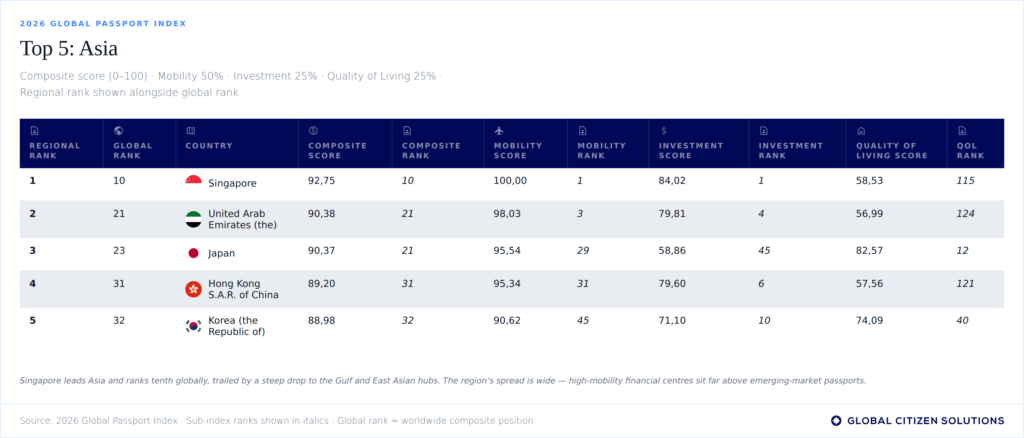
These are passports that compete with Europe’s best on raw access and, on several financial measures, beat them outright.
The bottom of the spectrum is just as extreme in the opposite direction. Afghanistan ranks 197th in the world, Yemen 194th, and Syria 193rd, clustered at the very floor of the global ranking. The gap between Singapore and Afghanistan is not a matter of degree; it is the difference between a document that opens nearly every border on the planet and one that opens almost none. Where Singapore scores a perfect 100 on visa-free mobility, Afghanistan scores zero. Tha single contrast captures the regional story more vividly than any average could.
What the leaders get right
The striking thing about Asia’s elite passports is how they win on financial freedom rather than lived comfort. On investment freedom, Singapore tops the entire world with 86.0 points, with Hong Kong second globally at 83.7 and the UAE fifth at 82.7. This is a clean sweep of the global investment podium by Asian financial hubs, something no European bloc achieves. The same dominance shows up in income: Singapore again ranks first in the world on national income per capita, at roughly $92,270, with the UAE tenth and Hong Kong thirteenth.
Tax is where the Asian hubs become almost untouchable. The United Arab Emirates posts the single best tax score on the planet — rank one globally, on the back of an effective burden near zero. Hong Kong and Singapore follow with light, business-friendly regimes. For anyone optimizing purely for capital, the Gulf-and-hubs axis offers a combination that the high-tax West simply cannot.
But the leaders are not uniformly strong. Japan is the revealing case. It holds an elite passport and a top-30 quality-of-life score, yet on tax it ranks 196th in the world — almost dead last — with an effective burden around 56 percent, closer to the Nordic welfare states than to its regional neighbors. Japan and Singapore both sit near the top of the regional table while representing opposite economic philosophies: one a high-provision, high-tax society, the other a low-tax financial hub. Their shared elite status is a reminder that there are multiple routes to a powerful passport.
Quality of life tells a different story

If the financial hubs dominate the money metrics, they fall back to the pack on livability. Singapore, for all its wealth, ranks only 130th globally on quality of life, and the UAE 124th — both well outside the leading group. Here it is Japan and South Korea that lead the region, at 28th and 40th respectively, tradin financial openness for social depth.
Happiness follows the same logic. The UAE and Singapore score moderately, in the global 30s and 40s, while Japan and South Korea — despite their developed economies — sit lower, in the 70s and 80s, reflecting well-documented social pressures. No Asian passport approaches the near-perfect happiness scores that the Nordic countries post in Europe. The continent’s strength is economic, not experiential.
The other Asia
For the citizens at the bottom of the ranking, these distinctions are academic. The numbers behind Afghanistan, Yemen and Syria describe not trade-offs but collapse. Afghanistan scores zero on both mobility and happiness — the latter the lowest reading anywhere in the index. Syria’s national income per capita ranks 195th in the world; Yemen’s quality of life sits at 194th. These are not passports with a weak dimension or two; they are documents stripped of nearly all functional value by conflict and state failure.
The contrast with the hubs only a few thousand miles away is the defining feature of Asian passport power. A Singaporean travels almost anywhere visa-free and pays almost nothing in tax; an Afghan citizen, on paper a holder of an Asian passport too, can travel almost nowhere at all. The regional label tells you nothing. Within Asia, the passport you hold determines not just where you can go but whether the wider world is open to you.
The bottom line
Asia rewards a narrow read and punishes a broad one. There is no “Asian passport profile” — there is the global elite of Singapore, the UAE and Japan, a strong middle of hubs and developed economies, and a tail of failed and conflict-torn states at the very bottom of the world ranking. For the wealth-focused, Asia’s best passports are arguably the most efficient on earth, pairing top-tier mobility with unmatched tax and investment freedom. For livability, the continent yields to Europe. And for the unlucky, an Asian passport can be among the least useful documents in existence. The continent’s high regional average hides all of this — which is exactly why the average is the least useful number in the dataset.
Americas: A Two-Tier Market
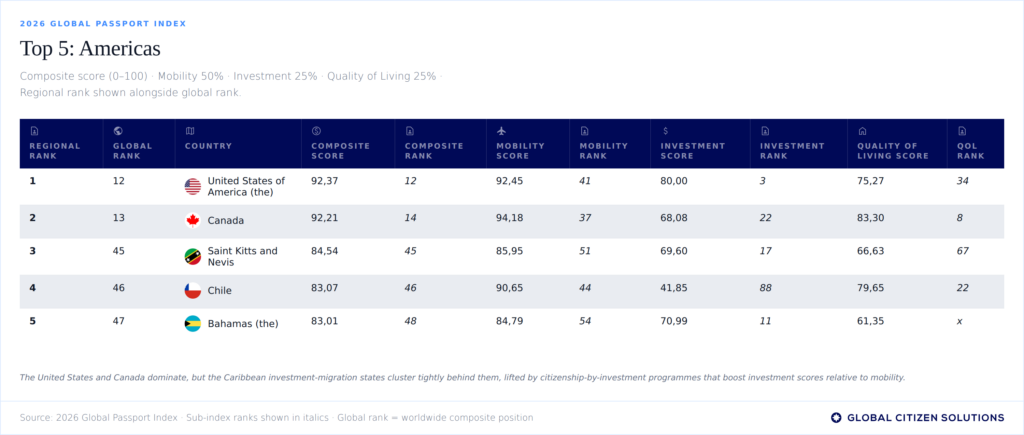
If Europe is a tightly packed elite and Asia a spectrum stretched to extremes, the Americas are something different again: a market split cleanly down the middle, with a vast gap where the middle ought to be. The Global Passport Index 2026 reveals a region defined not by gradual decline from top to bottom, but by a sharp cliff edge separating two North American giants from everyone else, and then, below that edge, one of the most instructive stories in the entire index.
At the top, the United States and Canada stand together and apart. The US leads the region at 12th globally with 92.37 points, with Canada just behind at 13th with 92.21. Both clear a composite score above 92, placing them firmly in the& global top fifteen alongside Europe’s best. They are powered by the kind of broad, balanced strength that defines elite passports everywhere: near-total visa-free reach, deep capital markets, and strong governance. The United States ranks fourth in the world on investment freedom and twelfth on income, while Canada posts a top-five global quality-of-life score. These are& unambiguously first-tier documents.
The third-ranked passport in the Americas (St Kitts and Nevis) sits at 45th in the world, more than thirty places below Canada. The drop from the North American pair to the rest of the region is one of the steepest discontinuities anywhere in the index. The Americas do not have a strong upper-middle tier; they have a top of two, and then a different conversation entirely.
The Caribbean’s quiet masterclass
That different conversation is where the region becomes genuinely fascinating. The Caribbean citizenship-by-investment programs tell one of the index’s most compelling stories, a demonstration that smart policy can manufacture passport power that a country’s raw economics would never predict.
Consider St Kitts and Nevis. It ranks 45th in the world overall, yet its national income per capita ranks only 60th. Its passport, in other words, punches well above the weight of its economy. The mechanism is visible directly in the sub-indices. On tax, St Kitts scores a perfect 100 (tied for first in the world) on the back of a zero-burden regime. The Bahamas does exactly the same, also posting a perfect global-best tax score. Antigua and Barbuda, Grenada, Dominica and St Vincent cluster just behind, each pairing light taxation with respectable visa-free mobility in the high-70s to low-80s.
The pattern is consistent and it is no accident. These small states have used well-managed foreign direct investment programs to build passports whose ranking far exceeds what their GDP or population would suggest. They cannot compete with the United States on income or with Canada on quality of life — their income figures sit in the global 60s, 80s and 100s, and their livability scores are modest. But on the two levers they can control — tax efficiency and negotiated visa-free access — they have engineered an outcome that lets a nation of tens of thousands of people offer a more globally useful passport than far larger and wealthier economies elsewhere. It is a vivid proof that, in the modern passport market, policy design can substitute for economic scale.
South America’s lonely standard-bearer
For all its size and population, continental South America is strikingly underrepresented at the top of the regional table. Chile is the only South American economy to crack the regional top five, ranking 46th globally with 83.07 points. It earns its place on the strength of solid all-round fundamentals rather than any single dominant metric, a top-25 quality-of-life score, strong mobility in the low-90s, and a middling tax and investment profile. It is the region’s most balanced non-North-American passport, but it stands largely alone.
Behind Chile, the familiar names of the continent (Brazil at 49th, Argentina at 52nd, Uruguay at 53rd) form a competent but unspectacular cohort. These are good passports by global standards, offering broad visa-free travel and reasonable livability. What they lack is any standout dimension that would lift them toward the elite. Brazil and Argentina both travel well, with mobility scores near 90, but their income and investment readings keep them anchored in the global middle. They illustrate the region’s broader truth: in the Americas, being a large, established economy is no guarantee of an elite passport, just as being a tiny island is no barrier to one.
The bottom line

The Americas reward a clear-eyed reading of what a passport is actually for. If the goal is the deepest possible package of mobility, wealth and governance, the United States and Canada are the only first-tier options the region offers, and the gap behind them is enormous. But if the goal is a tax-efficient, globally mobile passport obtainable through investment rather than birth, the Caribbean programs are among the most efficient instruments on the planet — proof that a well-run FDI strategy can deliver passport power untethered from a country’s economic size. South America, meanwhile, offers solid, dependable documents led by Chile, but no challenger to the North American summit. It is a region of two tiers and one important& lesson: in the passport market, how a country positions itself can matter as much as how large it is.
Africa occupies a unique place in the 2026 Global Passport Index. It is at once the region whose citizens face the steepest barriers to global movement and the region with the most room to change that through policy. Nowhere else does the gap between current reality and achievable potential loom so large. The continent’s story in the index is not one of failure so much as one of unrealized opportunity, and a handful of small states have already shown what is possible.
The proof of concept: Mauritius and Seychelles
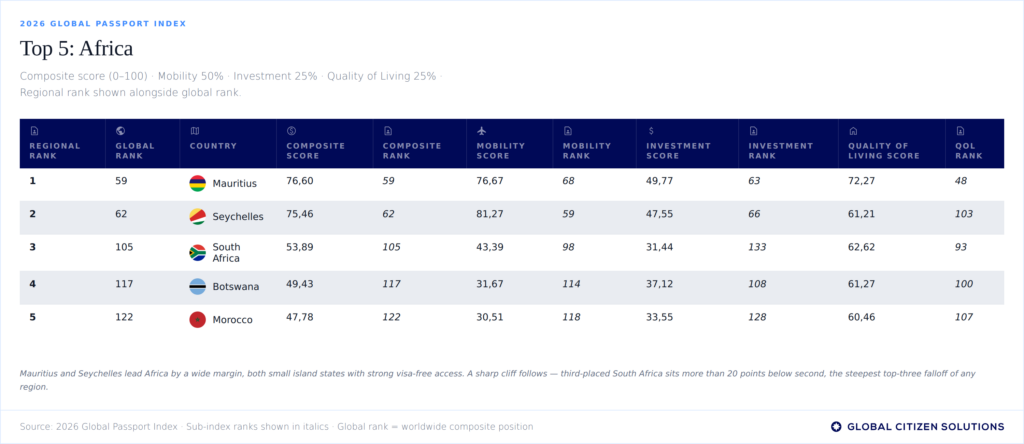
At the top of the regional table sit two island nations that quietly dismantle any assumption that an African passport must be a weak one. Mauritius leads the continent at 59th globally with 76.6 points, with Seychelles close behind at 62nd with 75.46. These are not merely the best of a weak field; they are scores competitive with mid-tier European countries, achieved by small, well-governed economies that have made mobility and openness a deliberate priority.
The sub-indices show how they do it. Both Mauritius and Seychelles post strong tax scores, tied at 37th in the world on the back of light 15 percent burdens, and both translate stable governance into visa-free reach far above their regional peers, Seychelles at 60th globally on mobility, Mauritius at 68th. Mauritius adds a respectable quality-of-life score and the continent’s highest income per capita figure. The lesson is unambiguous: size and location are not destiny. A small African state that governs itself well and negotiates access patiently can build a passport that opens most of the world.
The cliff behind the leaders
The trouble is how quickly the picture changes below those two. The third-ranked African passport (South Africa) sits at 105th in the world with just 53.89 points, more than forty places behind Seychelles. From there the regional top ten descends steadily through Botswana, Morocco, Namibia and the rest, all clustered between the global 110s and 130s. The drop from the island leaders to the continental mainland is severe, and it marks the boundary between the two Africas the index describes: a tiny well-governed vanguard, and a large cohort of capable states whose passports remain hemmed in by limited visa-free access.
The defining metric is mobility. South Africa scores only 41 on visa-free reach, Botswana 28, Morocco 19. These are economies with functioning institutions and meaningful regional weight, yet their citizens still face visa requirements across much of the world. This is precisely where the reform potential lies. The constraint is not poverty alone, it is a thin web of reciprocal visa arrangements that determined diplomacy can expand.
Kenya: the continent’s reformer
That is what makes Kenya the African story worth watching. Kenya has emerged as the continent’s standout policy reformer, pursuing openness as a strategic choice rather than waiting for it to be granted. Its current index position remains modest (its own citizens still face a low mobility score around 21) but the direction of travel is what matters. By moving to open its own borders and rethink its visa posture, Kenya is testing the proposition that African states can actively reshape their mobility standing rather than accept it as fixed. If the island nations prove what good governance can achieve over decades, Kenya is the test case for how quickly a larger mainland economy can move.
The largest mobility premium on earth
For the continent’s most populous nations, the index quantifies a gap that translates directly into lived constraint. Nigeria ranks 183rd in the world on mobility, Ethiopia 178th, and Egypt 175th — all near the very bottom of the global table, with visa-free scores in the single digits or low teens. For a Nigerian, Egyptian or Ethiopian citizen, the world is, on paper, largely closed.
This is exactly why the mobility premium available to these citizens through a second citizenship is among the largest anywhere in the world. The arithmetic is stark: a Nigerian passport opens a sliver of the globe, while a Caribbean citizenship-by-investment passport or a European one opens almost all of it. The leap in functional access, from a mobility score in the single digits to one in the high 80s or 90s, is a wider jump than a citizen of almost any other region could achieve. Where a wealthy European already enjoys near-total access and gains little from a second passport, an Ethiopian or Nigerian client stands to gain more, in pure mobility terms, than perhaps anyone else on the planet. The need is greatest precisely where the existing access is lowest, and that is what makes the second-citizenship value proposition so powerful across much of Africa.
The bottom line

Africa is the region where the index’s underlying message lands hardest. Mauritius and Seychelles prove that a well-governed African economy can reach the global mid-table on its own merits. Kenya shows that reform is not only possible but already under way. And the gulf facing citizens of Nigeria, Egypt and Ethiopia explains why, for them, a Caribbean or European second passport is not a luxury upgrade but a transformation in global access unmatched anywhere else. More than any other region, Africa is defined not by where its passports sit today, but by how far they could move — through governance, through diplomacy, and through the second-citizenship routes that close the widest mobility gaps in the world.
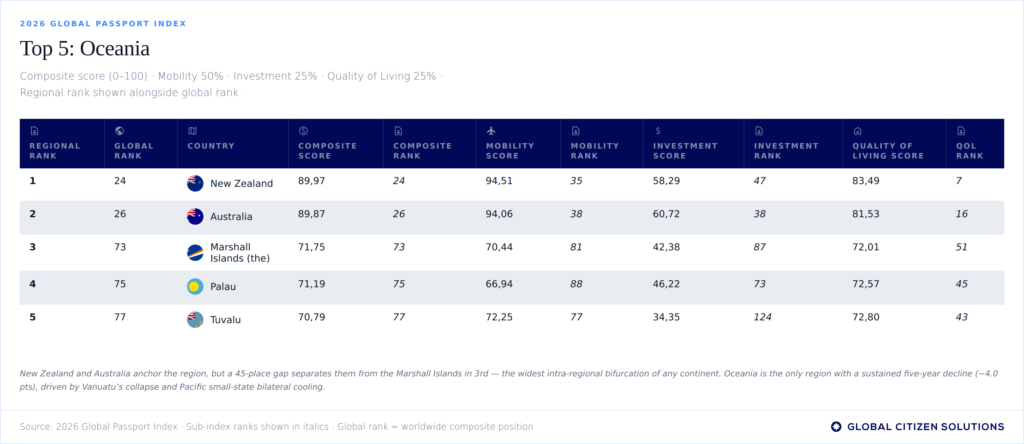
Of all the regions in the 2026 Global Passport Index, Oceania is the most lopsided. It is a continent with two world-class passports at the top, a near-empty space in the middle, and a cluster of small Pacific states whose ranking rests on a quite different foundation from the giants above them. No other region splits so cleanly or so dramatically between its leaders and the rest.
Two giants, quietly slipping
New Zealand and Australia anchor the region in the global top tier, ranking 24th and 26th in the world with composite scores of 89.97 and 89.87. Both are perennial favorites among high-net-worth families seeking lifestyle relocation, and the sub-indices explain why. New Zealand posts a top-ten global quality-of-life score and ranks ninth in the world on happiness; Australia is close behind on both. These are passports backed by exceptional living conditions, strong investment freedom, and broad& visa-free reach — the complete package that defines an elite document.
And yet the more revealing story is one of erosion. Both countries have lost ground over the past five years, New Zealand sliding from around 10th and Australia from roughly 18th to their current positions. The cause sits squarely in the mobility component. In the wake of the pandemic, a wave of bilateral visa re-impositions chipped away at the visa-free access these passports once enjoyed, and their formidable domestic strengths — quality of life, income, governance — could not fully offset the loss. New Zealand and Australia still score in the mid-90s on mobility, but the small reductions were enough to cost them more than a dozen places each. It is a pointed illustration of a lesson that runs through the whole index: travel access, not lifestyle, is the volatile variable, and even the strongest passports can drift when reciprocal arrangements tighten.
The widest gap on any continent
Below the two giants, Oceania opens into the widest internal chasm of any region in the index. The third-ranked passport — the Marshall Islands — sits at 73rd in the world, a full forty-five places behind Australia. There is no upper-middle tier here at all, no cluster of strong regional peers trailing the leaders. The drop is sheer, and it exceeds the bifurcation seen even in the Americas or Africa. Oceania is, more than anywhere else, a region of two giants and a long tail.
That tail is made up of the Pacific small states — Palau, Tuvalu, Tonga, Samoa, Micronesia and their neighbors — clustered between the global 73rd and 90th positions. What is striking about these passports is the source of their respectable standing. It is not outbound power. Their citizens hold modest visa-free reach, with mobility scores in the high 60s to low 70s, and their income figures sit low in the global table, several ranking past 130th. What lifts them is a different kind of openness: light tax regimes and accommodating inbound arrangements. The Marshall Islands, for instance, posts a strong global tax score of 30th, and Palau ranks among the world’s best on investment freedom. These are small economies that score well on the dimensions they can control — taxation and openness to capital and visitors — rather than on the genuine outbound mobility their citizens actually enjoy.
The bottom line
Oceania crystallizes a distinction the index makes everywhere but rarely so plainly: the difference between a passport that lets you in and a passport that lets you out. New Zealand and Australia offer genuine, broad-based power — elite mobility, top-tier living, deep institutions — even as recent bilateral frictions have nudged them down the table and shown that no passport’s reach is permanent. The Pacific cluster, by contrast, rounds out the regional top five on the strength of inbound openness and fiscal lightness rather than the global access their citizens can command. Between the two stands the widest gap on any continent, a reminder that in Oceania, more than anywhere, the regional label conceals two entirely different kinds of passport.
The 2026 ranking is the sixth annual edition of the Global Passport Index, and a five-year comparison illustrates both the relative stability at the top and the volatility in the middle and bottom tiers. Regional averages are summarised below.
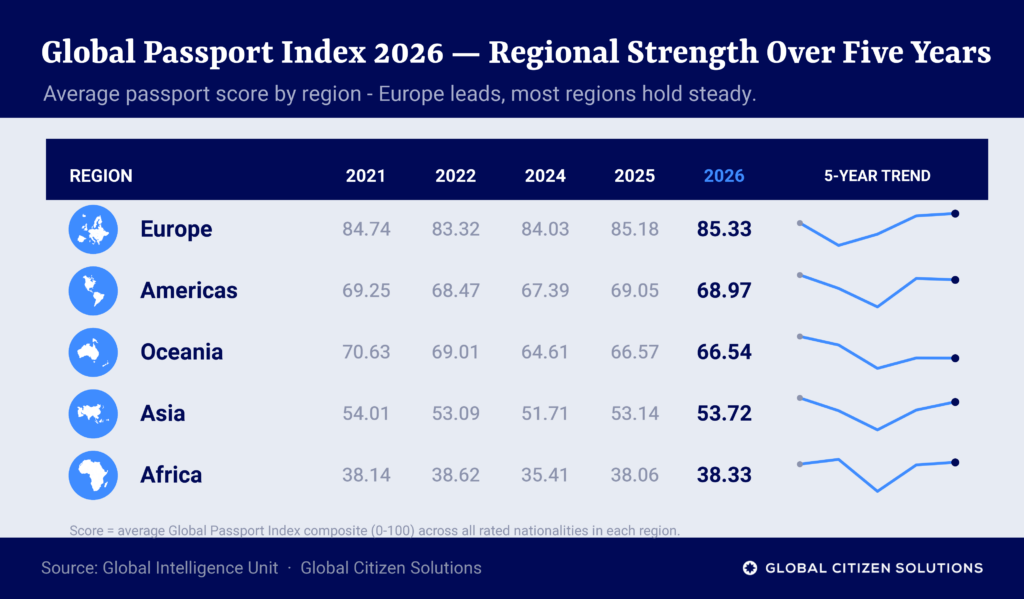
Three patterns emerge from the five-year comparison. First, Europe is the only region with a positive net trajectory across the period, gaining 0.6 points overall. Asia is essentially flat, having recovered from a 2024 low. Africa is similarly flat, with a modest gain in 2026 driven by the Kenya, Niger, and Sudan developments. The Americas show a small net decline of 0.3 points over five years, reflecting the post-pandemic re-imposition of US visa requirements by several Latin American partners. Oceania is the clear regional loser, declining by more than four points over the period — driven almost entirely by the Vanuatu collapse and the broader Pacific small-state difficulties.
Second, the dispersion within each region has widened. The standard deviation of country scores within Europe rose from 9.2 in 2021 to 11.4 in 2026, primarily because the Western Balkans gained ground while the post-Soviet states lost ground. In Africa the dispersion narrowed slightly as countries at both extremes converged toward the regional mean. The increasing internal dispersion of Europe and Asia is a direct consequence of geopolitical realignment: the war in Ukraine has separated Russia from European mobility integration, while EU-accession candidates Albania, Kosovo, and Bosnia and Herzegovina have moved closer to it.
Third, the top of the ranking is more stable than commonly perceived. Sweden has been first or second in every year of the index. The top ten in 2026 contains nine& of the ten countries that occupied that group in 2021 (Norway has replaced Belgium). The volatility is concentrated in ranks 30–80, where individual bilateral changes can move countries by ten to twenty places in a single year. This is the methodologically important corollary of the dominance of the Mobility pillar in the composite formula: countries in the middle band have more variance to gain or lose because their bilateral visa relationships are more contested.
The regional analysis confirms that passport power is not a single quality but a bundle of distinct advantages, and different regions have mastered different parts of that bundle.
Europe dominates because it has compounded every dimension simultaneously: mobility, governance, livability, and investment depth, over decades, producing passports whose strength is structural rather than situational.
Asia demonstrates that financial engineering and diplomatic reach can substitute for social provision, delivering world-class mobility and investment freedom without the welfare infrastructure that underpins Nordic dominance, while leaving quality of life as the region’s persistent gap.
The Americas reveal that policy design can matter as much as economic scale: the Caribbean’s citizenship-by-investment programs produce passport power that no measure of raw GDP would predict, while the
North American giants illustrate that breadth of strength, not any single metric, is what sustains a first-tier document.
Africa, more than any other region, is defined by the gap between where its passports sit and where deliberate policy could take them, Mauritius and Seychelles have already closed much of that gap, and Kenya is in the process of testing whether a larger mainland economy can move with similar intent.
Oceania distils the index’s most fundamental lesson: the difference between a passport that lets you into a country and one that lets you out into the world is the difference the index is really measuring, and no region makes that distinction starker. Taken together, the five regional pictures add up to a single finding.
The global passport hierarchy is not a league table of national wealth. It is a record of accumulated institutional choices (about openness, governance and investment opportunities, diplomacy, and social provision) made over generations, and the countries that sit at the top have, in most cases, made more of those choices more consistently than anyone else.
References
Global Citizen Solutions. (2024). Global Passport Index: Methodology. https://www.globalcitizensolutions.com/passport-index/methodology/
Global Citizen Solutions. (2025, January 29). Global Passport Report 2025. https://www.globalcitizensolutions.com/report/global-passport-index-2025/
Global Citizen Solutions. (2026). Enhanced Mobility Index. https://www.globalcitizensolutions.com/global-passport-index/enhanced-mobility-index/
Global Citizen Solutions. (2026). Global Passport Index 2026. https://www.globalcitizensolutions.com/global-passport-index/
Global Citizen Solutions. (2026). Singapore passport power and ranking 2026. https://www.globalcitizensolutions.com/singapore-passport-power-ranking/
Helliwell, J. F., Layard, R., Sachs, J. D., De Neve, J.-E., Aknin, L. B., & Wang, S. (Eds.). (2026). World Happiness Report 2026. Wellbeing Research Centre, University of Oxford; Gallup; UN Sustainable Development Solutions Network. https://www.gallup.com/analytics/349487/world-happiness-report.aspx
Heritage Foundation. (2026). 2026 Index of Economic Freedom: Highlights [PDF]. https://static.heritage.org/index/pdf/2026/2026_indexofeconomicfreedom_highlights.pdf
Heritage Foundation. (2025). 2025 Index of Economic Freedom: Executive summary [PDF]. https://static.heritage.org/index/pdf/2025/2025_indexofeconomicfreedom_execsummary.pdf
World Bank. (2024). GNI per capita, Atlas method (current US$). https://data.worldbank.org/indicator/NY.GNP.PCAP.CD
World Bank. (2024). GNI per capita, PPP (current international $). https://data.worldbank.org/indicator/NY.GNP.PCAP.PP.CD
World Intellectual Property Organization. (2024). Global Innovation Index 2024: Switzerland, Sweden, US, Singapore, UK top ranking [Press release]. https://www.wipo.int/en/web/global-innovation-index/w/news/2024/global-innovation-index-2024-switzerland-sweden-us-singapore-uk-top-ranking-china-turkiye-in
World Intellectual Property Organization. (2024). GII 2024 at a glance. Global Innovation Index 2024. https://www.wipo.int/web-publications/global-innovation-index-2024/en/gii-2024-at-a-glance.html
World Intellectual Property Organization. (2024). GII 2024 results. Global Innovation Index 2024. https://www.wipo.int/web-publications/global-innovation-index-2024/en/gii-2024-results.html
World Intellectual Property Organization. (2025). Global Innovation Index 2025. https://www.wipo.int/en/web/global-innovation-index/2025/index
Yale Center for Environmental Law and Policy & Center for International Earth Science Information Network, Columbia University. (2024). 2024 Environmental Performance Index. https://epi.yale.edu/measure/2024/epi
Yale Center for Environmental Law and Policy. (2024). 2024 Environmental Performance Index: A surprise top ranking, global biodiversity commitment tested [News article]. Yale School of the Environment. https://environment.yale.edu/news/article/2024-environmental-performance-index