
The pure visa-policy winners: Kosovo, UAE, and Oman
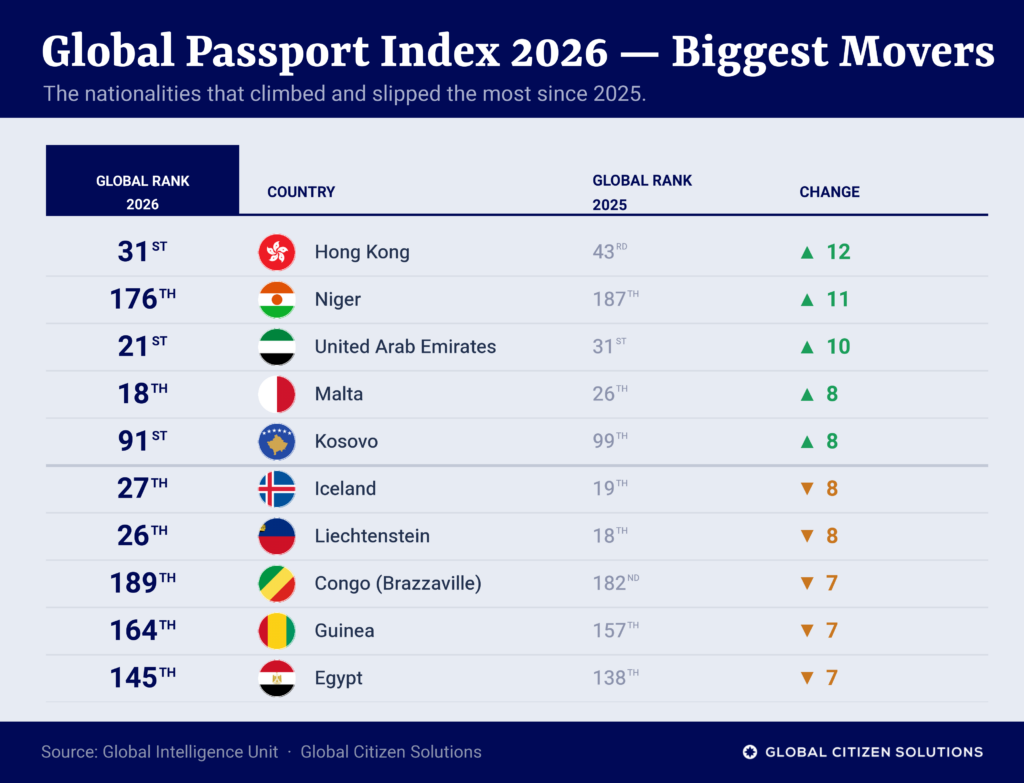
The cleanest mobility-driven gains in the 2026 edition belong to Kosovo, the UAE, and Oman, countries where new bilateral or multilateral travel arrangements visibly moved the needle. Kosovo posted the single largest jump of the year (+5.27 points, climbing eight ranks to 91st globally), driven overwhelmingly by a +10.51 surge in its mobility component as the EU’s January 2024 Schengen short-stay decision filtered through the index. The UAE’s headline gain understates a more dramatic underlying shift: its mobility-component rank leapt from 26th to 3rd, the second-largest mobility-rank move in the world, lifting it to 21st overall, the highest position ever for an Asian state outside the East-Asian top tier. Oman is the smaller-scale equivalent: a +3.00 mobility move drove almost the entire +1.71 score gain, while structural indicators like income and happiness stayed flat or declined. These three are the years’ clearest evidence that bilateral diplomacy still moves passport value.
The structural-reform winners: Albania, Saudi Arabia, Bahrain, and Hong Kong
A second group of risers gained ground for reasons that have little to do with new visa stamps. Albania (+2.60) jumped largely on the back of a +7.74 gain in its gender-equality index, a +4.96& lift in investment climate, and +4.34 in GNI per capita, institutional convergence toward EU candidate-country standards rather than mobility wins. Saudi Arabia (+2.10) is the cleanest Vision 2030 signal in the dataset: GNI +6.13, investment +3.16, gender index +3.25, happiness +2.84, with mobility playing only a secondary role. Bahrain (+1.73) registered the largest GNI-per-capita gain of any 2026 riser (+7.78) alongside material gains in investment and gender, but its mobility component barely moved at all, undermining any “Gulf tourism diplomacy” framing. Hong Kong (+3.61, climbing twelve ranks to 31st) was broader still, with mobility +6.46 leading but gender, investment, and freedom indicators all reinforcing.
The outliers: Sudan, Niger, and Dominica
Three risers don’t fit either bucket and deserve separate treatment. Sudan (+4.81) and Niger (+4.34) appear high on the leaderboard because they started near the global floor — Sudan’s 2025 mobility score was 0.36, leaving almost nowhere to go but up. Sudan’s +9.11 cost-of-living gain is best read as a methodological artifact of currency devaluation rather than improved welfare, and its SDG (−4.64) and GNI (−2.10) scores actually fell. Niger’s mobility rebound of 38 ranks is consistent with eased ECOWAS sanctions, but freedom (−2.29) and SDG (−1.73) deteriorated in parallel. Dominica’s +2.19 is something else entirely: a corporate tax rate cut from 35% to 25% drove a +17.35 jump in the tax sub-component —& by far the largest single-indicator move anywhere in the 2026 dataset — with mobility contributing barely +2 points. Each of these three is a real gain in composite terms, but none reflects the kind of durable underlying improvement implied by a clean “rising passport” narrative.
Set against US (−4.08), Canadian, and New Zealand declines from the global top 10, the pattern is real — though it’s better described as non-Western diplomatic outreach paying off than as a clean “small, wealthy, well-governed” story, since China, Vietnam, and Saudi Arabia all sit awkwardly inside that frame.
Five-year cumulative winners (2021 → 2026)
Kosovo’s 18-point gain over five years is by some distance the largest in the dataset and reflects the country’s transition from one of Europe’s least mobile passports in 2021 to one with EU Schengen short-stay access in 2024. China’s 6.5-point gain reflects the parallel expansion of Chinese visa-free reciprocity (particularly with European and Latin American states) alongside the unilateral Chinese opening, which raises destination quality for Chinese passport-holders. The Caribbean citizenship-by-investment programme states (Antigua, Saint Kitts, Dominica) all appear in the five-year top ten, driven by their economic diplomacy strategies.
Five-year cumulative losers (2021 → 2026)
The Vanuatu decline, almost nineteen points lost over five years, is the single most significant decline recorded in the index’s history. It reflects the European Union’s 2022 decision to suspend visa-free access for Vanuatu citizens; the suspension was made permanent in 2023. The Pacific small-state cluster (Samoa, Solomon Islands, Tonga, Palau) shows similar but smaller declines, reflecting a broader cooling of Pacific bilateral mobility relationships. Russia’s 4.5-point decline reflects the 2022–2024 sequence of Western visa restrictions, while the United States’ inclusion in the cumulative bottom (with a 4-point decline from 96.45 in 2021 to 92.37 in 2026) reflects post-pandemic bilateral re-impositions, including Brazil’s reinstated visa requirement.
Passport power is neither fixed nor random. It is the observable output of choices that governments make, and the 2026 edition makes the taxonomy of those choices unusually legible. Diplomatic negotiation, structural economic reform, fiscal policy redesign, and geopolitical alignment each leave a distinct fingerprint in the composite score, and the index has matured to the point where those fingerprints can be read separately. That granularity carries a practical warning: any passport whose mobility score rests heavily on a single dominant partner carries a concentration risk that the aggregate number conceals until the relationship breaks and the damage is already done. Vanuatu learned this in 2022. Russia is learning it now. The counterpoint is Kosovo: a country excluded from European mobility for reasons that were always more political than technical, whose eighteen-point gain over five years is not a statistical artefact but the belated collection of a dividend the country had already earned. The mobility was always latent; what changed was the political permission to access it. That distinction matters beyond the specific case. It suggests that a meaningful share of the passport inequality visible in the 2026 index is not the product of genuine national disadvantage but of solvable political problems dressed up as permanent structural ones. Position in the global passport hierarchy is not destiny. It is, more often than is comfortable to admit, policy, and policy, by definition, can change.
References
Balkan Insight. (2023, April 18). European Parliament votes to scrap visa regime for Kosovo citizens. https://balkaninsight.com/2023/04/18/european-parliament-votes-to-scrap-visa-regime-for-kosovo-citizens/
Clingendael Institute, Carnegie Europe, German Council on Foreign Relations, & Jacques Delors Institute. (2025, December 3). Albania’s EU accession sprint: Balancing momentum, reform, and EU scrutiny. Clingendael.https://www.clingendael.org/publication/albanias-eu-accession-sprint-balancing-momentum-reform-and-eu-scrutiny
Council of the European Union. (2022, March 3). Vanuatu: Council partially suspends visa waiver agreement due to risks posed by golden passport schemes. https://www.consilium.europa.eu/en/press/press-releases/2022/03/03/vanuatu-council-partially-suspends-visa-waiver-agreement-due-to-risks-posed-by-golden-passport-schemes/
Council of the European Union. (2022, November 8). Vanuatu: Council fully suspends visa-free travel agreement. https://www.consilium.europa.eu/en/press/press-releases/2022/11/08/vanuatu-council-fully-suspends-visa-free-travel-agreement/
Council of the European Union. (2024, December 12). Vanuatu: Council ends visa exemption. https://www.consilium.europa.eu/en/press/press-releases/2024/12/12/vanuatu-council-ends-visa-exemption/
European Commission, Directorate-General for Migration and Home Affairs. (2023, April 21). Kosovo visa liberalisation signed for entry in early 2024. https://home-affairs.ec.europa.eu/news/kosovo-visa-liberalisation-signed-entry-early-2024-2023-04-21_en
European Commission, Directorate-General for Migration and Home Affairs. (2024, January 3). Visa-free travel for Kosovo citizens to the EU. https://home-affairs.ec.europa.eu/news/visa-free-travel-kosovo-citizens-eu-2024-01-03_en
European Commission, Directorate-General for Neighbourhood and Enlargement Negotiations. (2025). Albania: EU accession overview and timeline. https://enlargement.ec.europa.eu/countries/albania_en
European Parliament. (2025). Report on the 2023 and 2024 Commission reports on Albania (A10-0106/2025). https://www.europarl.europa.eu/doceo/document/A-10-2025-0106_EN.html
Fragomen. (2022, November). Vanuatu/European Union: European Council fully suspends visa waiver agreement. https://www.fragomen.com/insights/vanuatueuropean-union-european-council-fully-suspends-visa-waiver-agreement.html
France 24. (2024, January 1). EU visa-free travel for Kosovo enters into force. https://www.france24.com/en/live-news/20240101-eu-visa-free-travel-for-kosovo-enters-into-force
German Council on Foreign Relations. (2025, December 11). Albania’s EU accession sprint [Policy brief]. DGAP. https://dgap.org/en/research/publications/albanias-eu-accession-sprint
Global Citizen Solutions. (2026). Global Passport Index 2026. https://www.globalcitizensolutions.com/global-passport-index/
Heritage Foundation. (2026). Index of Economic Freedom 2026. https://economicfreedom.heritage.org/
Radio Free Europe/Radio Liberty. (2023, April 18). EU lawmakers approve visa-free travel for citizens of Kosovo. https://www.rferl.org/amp/eu-lawmakers-approve-visa-free-travel-kosovo-/32369241.html
Saudi Vision 2030. (2025). Vision 2030 annual report 2025. https://www.vision2030.gov.sa/en/annual-reports
Saudi Vision 2030. (n.d.). Vision 2030: Overview. https://www.vision2030.gov.sa/en/overview