
The 2026 composite Global Passport Index synthesises three weighted pillars: Enhanced Mobility (50 per cent of the composite), reflecting outbound visa access weighted by destination quality; Investment (25 per cent), reflecting GNI per capita, personal income tax rates, and innovation indicators; and Quality of Living (25 per cent), reflecting happiness, environmental performance, freedom indices, and migrant acceptance. The composite is calculated for 197 countries on a 0–100 scale.
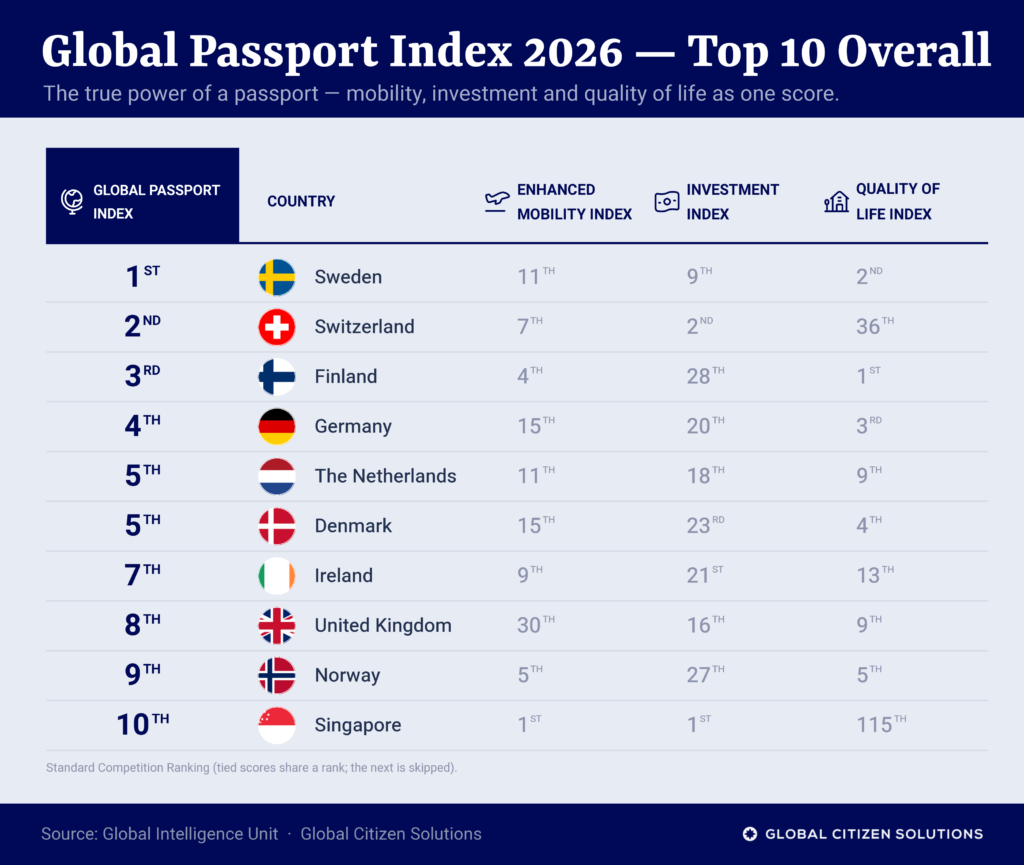
The top of the 2026 ranking is overwhelmingly European, with nineteen of the top twenty countries drawn from Europe and the Americas. Singapore is the sole Asian entrant in the global top 20, ranking tenth. Within Europe, the Nordic states cluster at the apex: Sweden, Finland, Denmark, and Norway all rank in the top nine, joined by Switzerland, Germany, the Netherlands, Ireland, and the United Kingdom. The composite scores at the top are tightly bunched: from Sweden’s 96.05 to Norway’s 93.00 the gap is barely three points, reflecting the convergence of wealthy democracies around a similar combination of mobility access, investment attractiveness, and quality-of-living indicators.
Two outliers in the top 20 deserve note. The United States ranks twelfth (fourteenth in 2025) with a composite score of 92.37 despite being among the five most restrictive destinations in the world by inbound openness: the divergence between US passport strength and US destination openness is the largest of any country in the world.
Singapore combines the world’s highest mobility score (114.23) with relatively modest quality-of-living scores (rank 115). Ranking 10th globally with a score of 92.75 out of 100, the only Asian passport to crack the worldwide top ten. It edges out the United Arab Emirates (90.38) and Japan (90.37) by a comfortable margin, reflecting the strength of Singapore’s diplomatic reach, mobility access, and the broader institutional stability that underpins its travel document. The score does mark a slight softening from 2025, when Singapore held 9th place globally with 93.17 points, but its regional leadership in Asia remains unchallenged in this year’s index.
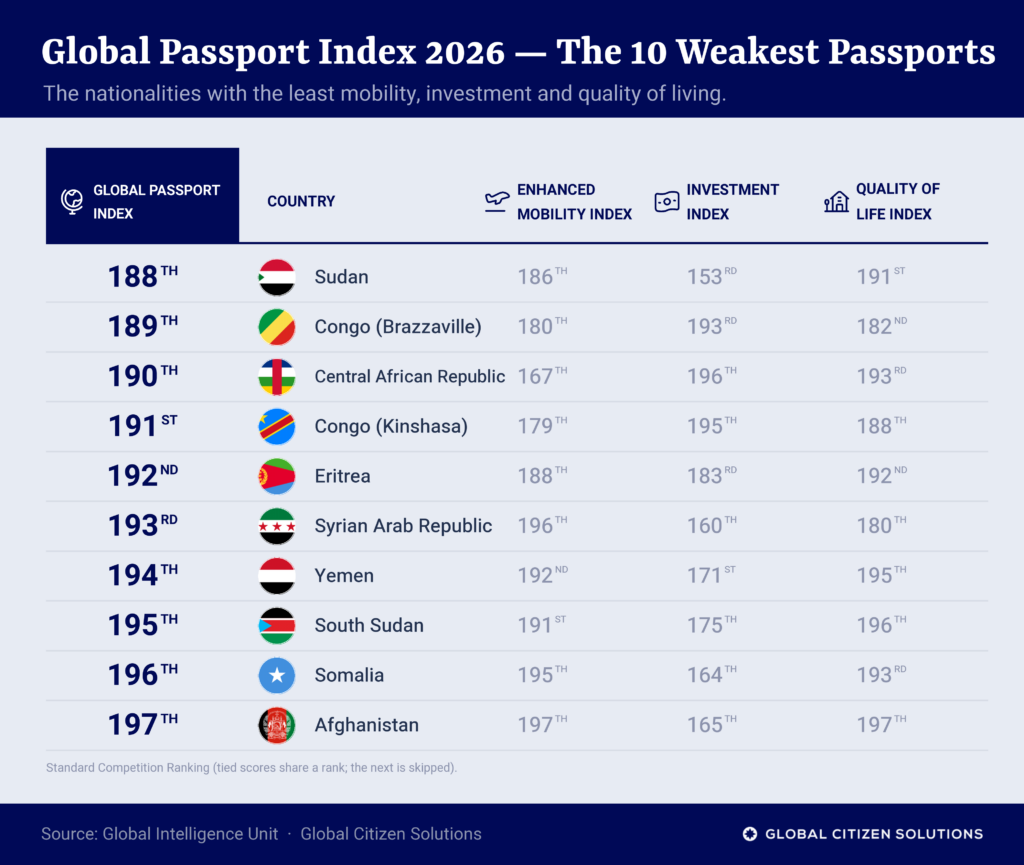
The bottom of the 2026 ranking is dominated by African states (fourteen of the twenty lowest-ranked countries) and conflict-affected Asian states (Afghanistan, Yemen, Syria, Pakistan, Myanmar, Lao PDR). Haiti is the only entry from the Americas in the bottom twenty. The composite scores at the bottom span 23–34, indicating that even the highest-ranked country in the bottom group (Lao PDR at 33.91) operates in a fundamentally different mobility regime from the lowest-ranked country in the top half.
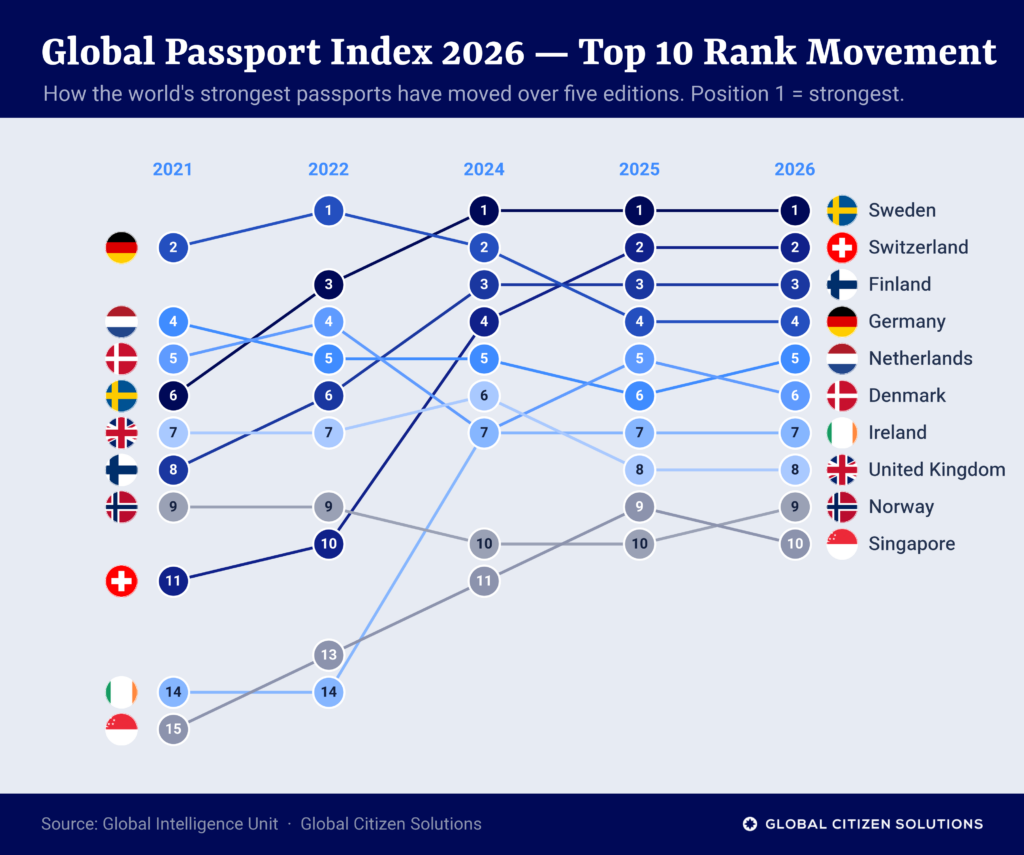
The gap between the world’s strongest and weakest passports has stayed above 72 points in every edition since 2024, compared with 70 points in 2021 and 67 in 2022, the widest sustained spread the GPI has recorded.
In 2026, Sweden (96.05) sits 72.95 points above Afghanistan (23.10), and while the gap has narrowed marginally from the 2025 peak of 73.6, the bottom of the index has lost ground every single year since 2021, even as the top has gained.
The 2026 Global Passport Index confirms a pattern that has hardened over successive editions: the gap between the world’s most and least powerful travel documents is not narrowing but entrenching. The top of the ranking reflects the compounding advantages of wealthy democracies, broad visa-free access, high institutional quality, and investment attractiveness, that reinforce one another in ways that are increasingly difficult for lower-ranked states to challenge. Yet the index also surfaces more nuanced stories within that broad picture: the United States, whose passport commands extraordinary outbound mobility, simultaneously operates one of the world’s most restrictive inbound regimes, a contradiction unique in its scale; and Singapore, whose ascent to the top of the Asian ranking rests on diplomatic reach rather than size or wealth, demonstrating that strategic foreign policy can substitute, to a degree, for the historical advantages that underpin European dominance. At the bottom, the clustering of conflict-affected and low-income states reflects structural conditions, political instability, weak bilateral relationships, limited economic leverage, that visa policy alone cannot address.
The sustained and widening spread between the index’s ceiling and floor is, in this sense, less a passport story than a development story: mobility inequality at the individual level increasingly mirrors, and amplifies, inequality at the national one.